Portfolio
The mini-projects we showcase here were carried out at colaps as part bachelor’s and master’s theses, praxisprojects or small-scale research. Click here to view past projects.
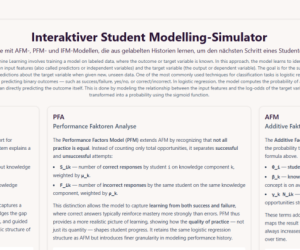
Yannick Haußmann designed a web-based simulation for teaching supervised machine learning student models (AFM, PFA, IFM) in intelligent tutoring contexts. The system offers interactive model training, step-by-step simulation with live formulas, and analytic visualizations to make underlying mechanisms transparent. A mixed-methods evaluation using questionnaires, eye-tracking, interaction logs, and interviews assessed usability, usefulness, attention patterns, and conceptual understanding.
Yannick Haußmann, “Design and implementation of interactive simulations for data-driven, machine-learning student models”, Master’s Thesis, December 2025.
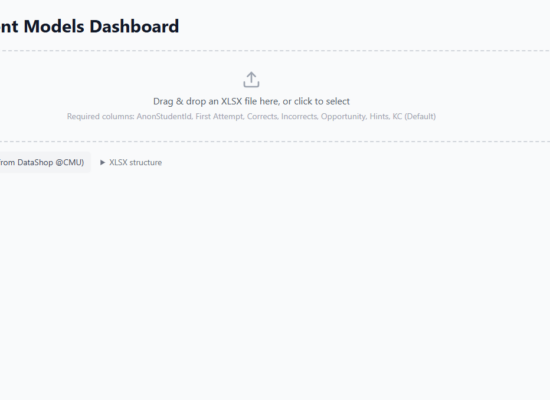
This project presents a dockerized web application that lowers the barrier to Item Response Theory (IRT)-based student modelling by removing the need for programming skills. Users can upload data to train three student models — AFM, PFM, and IFM — implemented in both Python and R. The application evaluates model performance and accuracy, displays parameters transparently, generates comparative visualizations, and allows results to be exported as a ZIP file, making IRT modelling accessible to non-technical educational researchers.
Yasin Esiri, “A flexible infrastructure for training configurable, machine-learning student models”, Bachelor’s Thesis, June 2023.
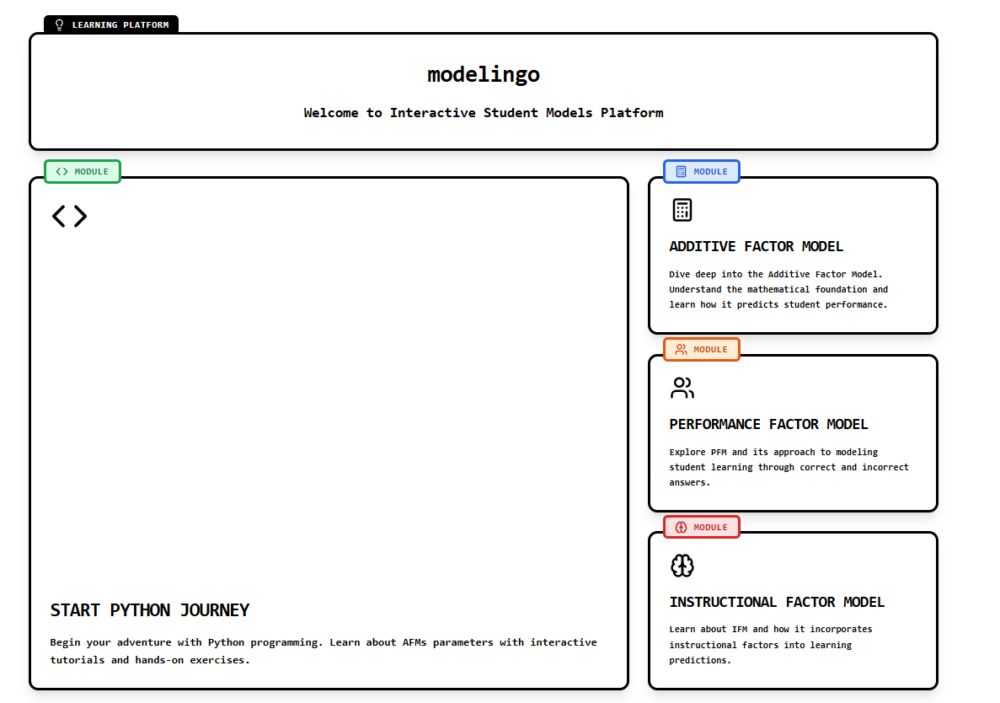
This research investigates how learners interact with an XAI-ED simulation explaining three student models (AFM, PFM, IFM) through think-aloud protocols and interviews with master’s students. Qualitative analysis revealed two distinct learner profiles— Strategy-Deploying and Overwhelmed — showing that identical explanations produce very different processing patterns. Findings support “Staged Transparency” as a feasible design approach and highlight the need for adaptive scaffolding and early learner-type detection.
Raphael Stedler, “Design, Implementation and Evaluation of Human-Centered, Interactive Simulations for Explainable Student Models”, Master’s Thesis, December 2025.
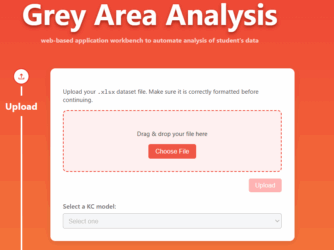
For his bachelor’s thesis, Danial developed a web-based workbench that automates learning analytics on student log data, making analysis accessible to non-technical educators. Built with Angular, Flask, and R Markdown, and containerized via Docker, the system lets users upload datasets, configure parameters, and generate PDF or HTML reports. It extends a prior static-script prototype into a modular, usable application. The work addresses a recognized gap between raw learning data and actionable teaching insights, prioritizing usability, reproducibility, and adaptability.
Danial Norouzi, “Design of a web-based application workbench to automate analysis of students’ data”, Bachelor’s Thesis, September 2025.