
We had a great time at the Festival of Learning / AIED 2026 in Seoul, South Korea presenting our work, meeting old and new friends and colleagues 🙂 You can see a short video about our adventures here: https://youtu.be/7geVdmw_5J8?si=Aj-NSel8Mtn6-mLM
This year, the group had 4 main contributions:
- Kai presented our paper “Beyond one-size-fits-all: personalizing computational proxies of the zone of proximal development through help-seeking behaviors“.
 This paper proposes a computational representation of the Zone of Proximal Development (ZPD) for intelligent learning environments that allows for personalization according to students’ knowledge and help-seeking behaviors. Modeling students’ cognitive state is essential for providing students with appropriate feedback in terms of meeting their needs and supporting effective learning. However, previous computational proxies of the ZPD often treat the optimal learning zone of students as uniform, overlooking differences in how individual students respond to challenges and seek help. To address this challenge, we used an existing ZPD proxy (the Grey Area, GA) and further enhanced it to automatically adjust its characteristics depending on students’ needs for assistance. To evaluate our approach (P-GA), we analyzed students’ performance after receiving scaffolding over four datasets and compared it to the original proxy. Our findings suggest that P-GA outperforms the standard GA. Additionally, P-GA allows the identification of students who exhibit unsuccessful help-seeking behaviors, as well as students who use successful help-seeking patterns. This work contributes toward theory-driven instructional decision-making in AI-assisted tutoring and scaffolding.
 - We conducted the workshop “Open Learner Models in the Age of Generative AI” with the contribution of Diego Zapata-Rivera and Tomohiro Nagashima.
 Research in Open Learner Models (OLMs) has long explored how enabling learners to review and interact with a learner model can support learner metacognition and agency by making learner representations transparent and inspectable. Nowadays, Generative AI, and in particular, Large Language Models (LLMs) create both an opportunity and a challenge for OLMs: while LLMs can generate rich, naturalistic explanations of learner states and lower the cost of OLM development, they lack the structured, inspectable representations that give OLMs their epistemic integrity. During the workshop we brought together researchers and practitioners to critically examine this tension and explore how OLMs can leverage the communicative power of LLMs without sacrificing transparency, validity, and learner agency. Through opening provocations, a state-of-the-art presentation, and a hands-on design challenge, workshop participants collectively developed a research agenda (more about this to follow soon).
 - We presented our IP101-LabMate tutoring environment during the Interactive Events Track 🙂

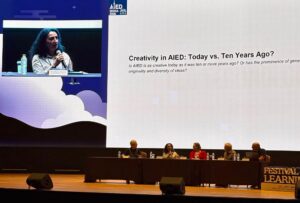
IP101-LabMate is an AI-enhanced JupyterLab environment that embeds Large Language Model (LLM) support directly into the student’s programming workflow. The system delivers two just-in-time feedback modes: worked examples and textual instructions. Both modes are generated by an LLM based on the given task description, the student’s source code, and the corresponding traceback. For each task, students receive up to three hints that progressively increase in detail. The platform’s architecture is modular, and readily redeployable for different subjects, LLM backends, or feedback strategies. IP101-LabMate was piloted successfully during a semester-long bachelor-level programming course with approximately 200 students in WiSe 2025/26. - Irene participated in the panel discussion “Old AIED, New AI” with Art Graesser, Didith Rodrigo, Carrie Demmans-Epp and Emmanuel Blanchard, who organized and coordinated the panel.
- We’re now reflecting on the interactions and input we got from the Festival of Learning 2026 to plan the year ahead! We’re also day-dreaming about the great experiences we had in Seoul, a really magical place <3