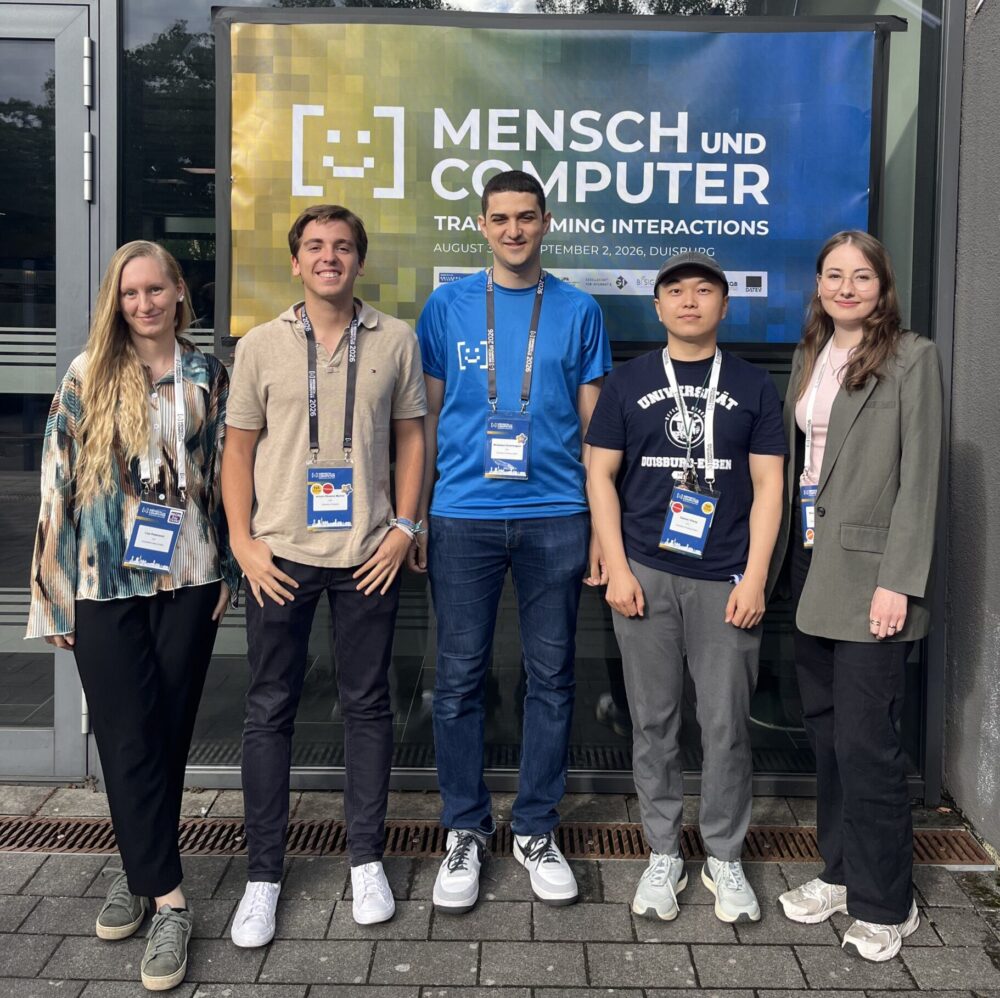
We recently wrapped up an exciting and inspiring experience at Mensch und Computer 2026, where we had the opportunity to share our research, exchange ideas, and connect with researchers and practitioners from the Human–Computer Interaction community. Our contributions are the following:
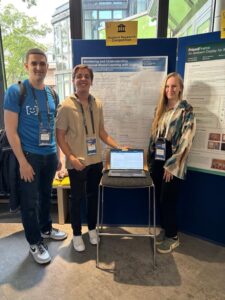
- Arturo and Lisa presented their work, “Monitoring and Understanding Notebook-Based Learning with Jupyter” as part of the Student Research Competition. While coding, students often get stuck in repetitive trial-and-error debugging, with limited real-time awareness of their own workflow. To address this challenge, they developed a learner-facing Project Jupyter dashboard extension designed to run alongside the notebook while students code. By capturing cell executions, retries, and errors on the fly, the extension transforms otherwise hidden programming patterns into visual timelines and actionable reflection cues. At the same time, the design aims to maintain a low cognitive load, assessed using the NASA-TLX, during active coding tasks. This project was developed as part of the Learning Analytics course during the winter semester 2025/2026, under the supervision of Mohamed, Kai, and Irene.
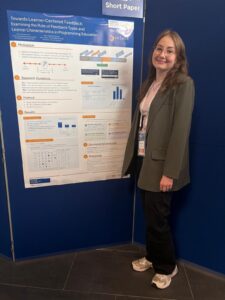
- Mona presented our paper “Towards Learner-Centered Feedback: Examining the Role of Feedback Types and Learner Characteristics in Programming Education“ as a short paper in poster form. This paper investigates how different types of automated feedback relate to performance, perceptions, and hint-request behavior in programming education, and explores whether individual learner characteristics, such as gender and self-assessed experience, additionally shape these outcomes. To this end, we conducted a mixed-methods study with 45 higher education students, comparing three conditions: textual hints, worked examples, and no feedback. Our findings showed no significant differences related to learner characteristics, but worked-example feedback led to significantly higher task performance than the other conditions. Qualitative interviews further revealed that learners valued clear structure, gradual guidance, and access to worked solutions, while hint-request patterns pointed to both productive and less productive help-seeking strategies.
- Kai presented our paper, “Exploring LLM-generated Hints for Students’ Error Recovery in Programming“, looked at how LLMs should support students when they hit coding errors — and whether that support needs to change based on how experienced the student is. We ran a field study in two university programming courses (75 students total), building error-triggered LLM support directly into JupyterLab., When a student hit an error, they got one of three things: no support, generic support (just the error type), or tailored support (the error type, traceback, and their actual source code). Tailored support worked best by far — students recovered from errors more than twice as often compared to no support. And notably, this held equally for both Bachelor’s and Master’s students — the benefit didn’t depend on prior experience. Our takeaway: LLM support in learning environments should be built as contextual scaffolding, not a generic error explainer– automatically feeding the model the student’s code and traceback rather than expecting students to describe their own bugs. Next up: using that context to generate hints rather than solutions, so students still do the work of debugging.

As we look back on our time at Mensch und Computer 2026, we are taking with us not only new ideas and perspectives, but also the valuable conversations, feedback, and connections we made throughout the conference. The insights we received will continue to inspire and shape our research in the months ahead.