The mini-projects we showcase here were carried out at colaps as part bachelor’s and master’s theses, praxisprojects or small-scale research.
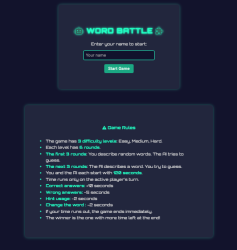
For their Bachelor’s thesis, Kimia investigated how users experience a word-guessing game powered by a locally hosted LLM. The motivation is to understand how natural language interaction with an AI affects user engagement and usability in a playful context.
(Kimia Beheshti Zavare, “Design and Implementation of a Web-based Word Game Supported by a Large Language Model.“, Bachelor’s Thesis, July 2025).
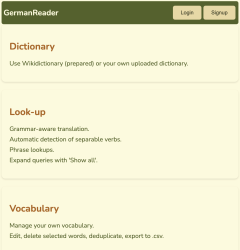
While numerous reader apps are available, they often fall short in effectively addressing the unique challenges faced by learners of the German language. To address these challenges, we aimed to design an effective reading app using Angular for the front end and Flask for the back end, incorporating various external libraries and dictionary sources.
(Ha Thuong Tran, “Development of a web-based e-book reader app with lexicon support for promoting language learning”, Bachelor’s Thesis, 2024)
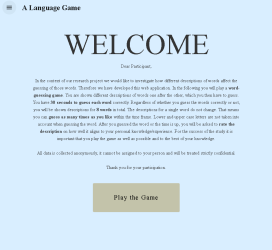
“This web-based word game aims to explore intersubjectivity in Human-AI collaboration. We define collaboration as teaming a human with a Large Language Model (LLM) to achieve a shared objective: maximizing the team’s score in the game. During the game, participants are asked to guess target words based on pre-generated textual descriptions that are sometimes generated by humans and sometimes generated by an LLM. The original version of the game was developed for the praxisproject “Me-and-my-Chat-GPT: Human-Machine Communication with Text Generators” in the summer semester 2023 student group “Language-Game”: Valentin Buckels, Paul Guyet, Carlo Maryska, Ha Thuong Tran, Qiu Xinny, Ali Haydar Zorluer). The updated version that is presented here was developed by Ha Thuong Tran and Yasin Esiri.
Imprint/Impressum – University Duisburg-Essen, LF Building, Lotharstr. 65, 47057 Duisburg, Germany
Copyright © 2024 – colaps

