Explainable & Interactive Learning Simulations
The mini-projects we showcase here were carried out at colaps as part bachelor’s and master’s theses, praxisprojects or small-scale research.

MurderMysterAI - AI Literacy Visual Novel Game
MurderMysterAI is a web-based visual novel game designed to teach players about core artificial intelligence (AI) concepts through interactive storytelling and minigames. The story follows a detective and their AI assistant, CatAI, as they solve the mysterious death of AI researcher Dr. Sommer. The game is aimed at improving AI literacy, including topics like data bias, model training, perception limitations, and ethical AI decisions.
Xueni Hao, “Design and Implementation of a Narrative-Driven Game
for Promoting Artificial Intelligence (AI) Literacy“, Bachelor’s Thesis, September 2025.
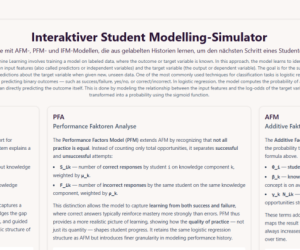
Yannick Haußmann designed a web-based simulation for teaching supervised machine learning student models (AFM, PFA, IFM) in intelligent tutoring contexts. The system offers interactive model training, step-by-step simulation with live formulas, and analytic visualizations to make underlying mechanisms transparent. A mixed-methods evaluation using questionnaires, eye-tracking, interaction logs, and interviews assessed usability, usefulness, attention patterns, and conceptual understanding.
Yannick Haußmann, “Design and implementation of interactive simulations for data-driven, machine-learning student models”, Master’s Thesis, December 2025.
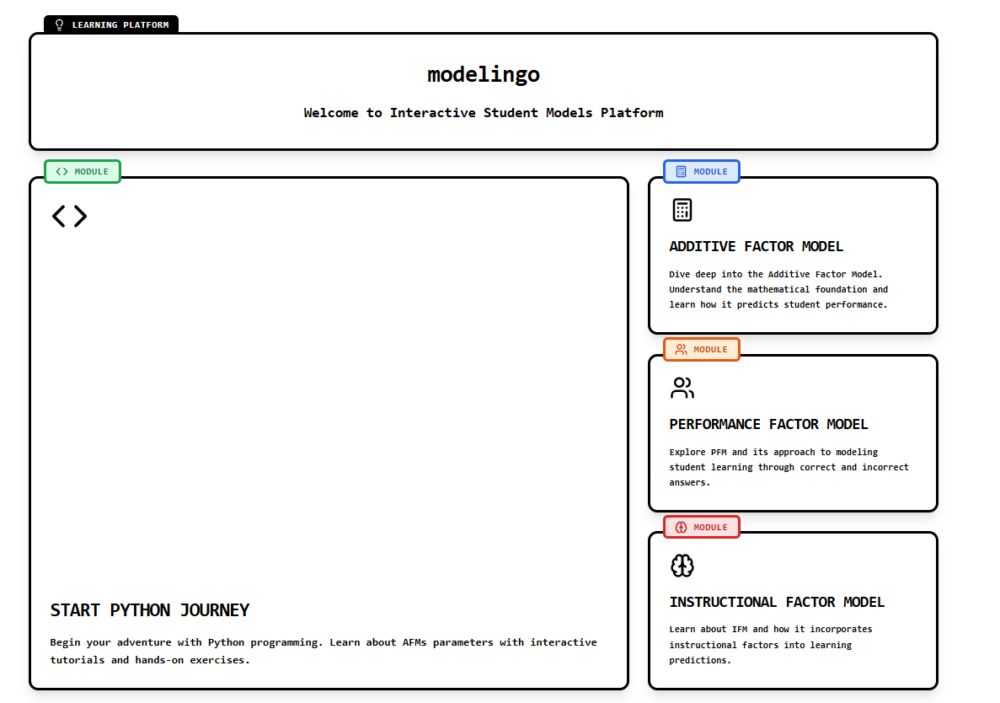
This research investigates how learners interact with an XAI-ED simulation explaining three student models (AFM, PFM, IFM) through think-aloud protocols and interviews with master’s students. Qualitative analysis revealed two distinct learner profiles— Strategy-Deploying and Overwhelmed — showing that identical explanations produce very different processing patterns. Findings support “Staged Transparency” as a feasible design approach and highlight the need for adaptive scaffolding and early learner-type detection.
Raphael Stedler, “Design, Implementation and Evaluation of Human-Centered, Interactive Simulations for Explainable Student Models”, Master’s Thesis, December 2025.