Student Modeling & Learning Analytics
The mini-projects we showcase here were carried out at colaps as part bachelor’s and master’s theses, praxisprojects or small-scale research.
MindTheGap
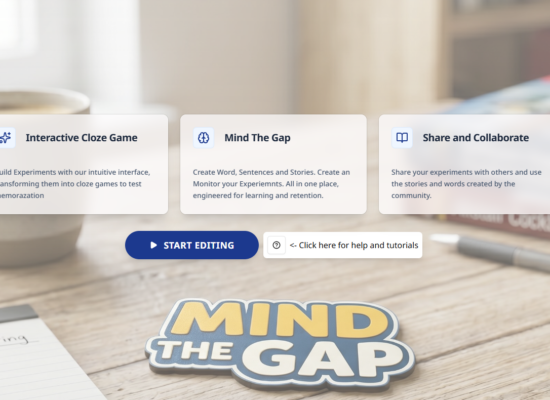
AI assistants in everyday learning promote cognitive offloading, reducing the mental effort
learners invest in spelling acquisition. To study this effect and the counteracting role of desirable
difficulty (cognitive friction), this thesis develops a full-stack web application for running
experiments in EFL contexts. Investigators build hierarchical, within-subjects memorization
experiments using cloze spelling tasks with automated audio generation. Control participants
receive Passive Correction feedback, while treatment participants receive Active Recall. A PostgreSQL database and immutable downloadable snapshots ensure data consistency and support offline execution. Usability evaluations confirmed the prototype as a scalable, reliable
instrument for studying cognitive offloading’s impact on long-term vocabulary retention.
Holger Staubach, “Design and Implementation of a Software System for Managing and Executing
Experiments on the Influence of Cognitive Offloading on Memorization in EFL (English as a Foreign
Language) Contexts”, Bachelor’s Thesis, July 2026
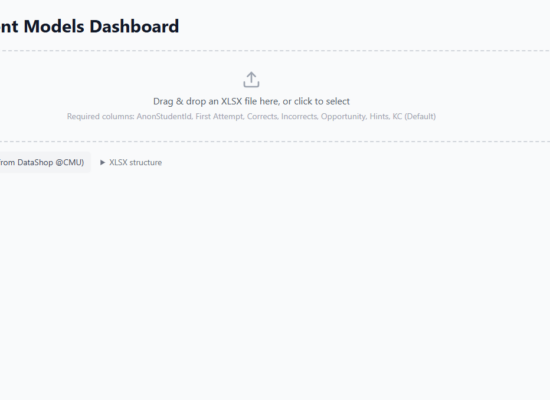
This project presents a dockerized web application that lowers the barrier to Item Response Theory (IRT)-based student modelling by removing the need for programming skills. Users can upload data to train three student models — AFM, PFM, and IFM — implemented in both Python and R. The application evaluates model performance and accuracy, displays parameters transparently, generates comparative visualizations, and allows results to be exported as a ZIP file, making IRT modelling accessible to non-technical educational researchers.
Yasin Esiri, “A flexible infrastructure for training configurable, machine-learning student models”, Bachelor’s Thesis, June 2023.
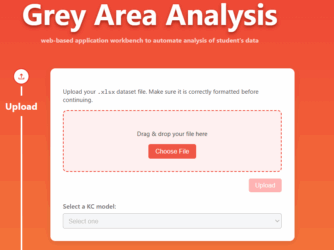
For his bachelor’s thesis, Danial developed a web-based workbench that automates learning analytics on student log data, making analysis accessible to non-technical educators. Built with Angular, Flask, and R Markdown, and containerized via Docker, the system lets users upload datasets, configure parameters, and generate PDF or HTML reports. It extends a prior static-script prototype into a modular, usable application. The work addresses a recognized gap between raw learning data and actionable teaching insights, prioritizing usability, reproducibility, and adaptability.
Danial Norouzi, “Design of a web-based application workbench to automate analysis of students’ data”, Bachelor’s Thesis, September 2025.